Posts

Showing posts with the label 1970s

Suspiria (1977)

Image
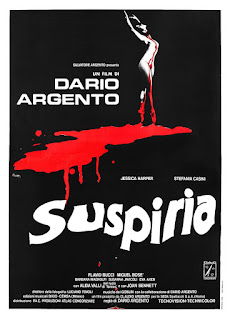
Day 161 of Sobriety.  What could I possibly say about Dario Argento’s Suspiria that hasn’t been said already? Not much I don’t think. I’ve seen it several times before, but this re-viewing was prompted by wanting to watch it with my wife, because we recently watched (and enjoyed) Edgar Wright’s Last Night in Soho (2021) together, and I was keen to show her where a good deal of that film’s visual style originated. We also watched the 2018 remake of Suspiria a while back, and I think she liked it (I do). While I now consider the 1977 Suspiria to be a classic, I remember being underwhelmed when I first saw it in my late teens or early twenties—thinking it was OK, but being bewildered as to why it was held in such high acclaim. I think my only exposure to Dario Argento prior to that was via his involvement in Lamberto Bava’s Demons (1985), which was much more up my teenage alley. Although I am certain that the impression Suspiria made on me back then was greatly impaired by watchin...

The Possession of Joel Delaney (1972)

Image
Day 131 of Sobriety.   This was an odd one. I’m still not quite sure what to make of 1972’s The Possession of Joel Delaney , perhaps because it was so different from my expectations, which were based almost entirely on seeing a trailer for the film a while back. Based on that trailer, I had expected it to be a film about demonic possession of the type that proliferated somewhat in the early to mid 70s, but with a more pronounced period modishness than its contemporaries like The Exorcist (1973) or The Omen (1976). I guess it kind of was, but it was also pretty different in approach and feel to those other movies, of which it is generally regarded as a precursor.   The plot revolves around a wealthy Manhattan divorcee (played by Shirley MacLaine) who comes to believe that her brother is possessed by the spirit of a deceased serial killer. One of the things that distinguishes it from other possession-based films of the period is that, unlike the generally Christian-based notio...

The Child (1977)

Image
Day 109 of Sobriety. The Child was my last film to watch from Arrow Video's American Horror Project: Volume 2 set. I enjoyed the other two films in the set— Dream No Evil (1970) and Dark August (1976) and  so I was looking forward to another film in line with what I have come to expect from these sets: a left-field, low-key, eccentric, low-budget horror film. And that is exactly what I got. The plot is about a young woman who goes to work as a nanny in an isolated mansion in rural California. The mansion is situated in the middle of thick woodland, and is inhabited by the aging patriarch, his adult son, and young daughter. The mother of the family is dead, having been murdered in the woods by tramps several years prior—an incident which has cast a dark shadow over the house and all of its inhabitants. It is not long before the young nanny discovers that all is not well in the household, particularly with regards to the young daughter the eponymous “child” of the fil...

Eyeball (1975)

Image
Day 108 of Sobriety.  Eyeball is a giallo by Umberto Lenzi, who is perhaps best known to horror fans for directing a couple of the better-known Italian cannibal films, including the notorious Cannibal Ferox (1981). His resume also includes a number of other well-regarded giallo and poliziotteschi (crime films). Not much in the way of straight-up horror, but he did direct 1988’s Ghosthouse (AKA La Casa ), which I watched recently and wrote about on this blog. The plot follows a group of American tourists who are traveling around Spain on a tour bus, and who start to get murdered one-by-one by an unknown killer whose trademark is gouging out one of the victim’s eyeballs. I don’t know why I keep watching movies like this, but I do. Objectively speaking, pretty much every aspect of Eyeball is ridiculous. The characters that comprise the small tour group are all complete oddballs: a lesbian “photographer” and her model girlfriend, a bickering couple comprising a bitchy ...

The Devil’s Men (1976)

Image
Day 85 of Sobriety.  Also known in its truncated form (minus all the blood and nudity) as Land of the Minotaur , The Devil’s Men is a very strange Greek production from 1976 starring Donald Pleasence and Peter Cushing. The goofy plot is about an Irish priest living in Greece who enlists the aid of a New York detective and a young, nubile archeology student to investigate an evil Minotaur-worshiping cult that is abducting and sacrificing tourists. At first, probably due to the presence of Peter Cushing, I thought this was going to a passable stand-in for a similar period Hammer production, but I was stripped of that delusion pretty quickly. This movie is pretty dumb and schlocky. The plot is absurd, as is most of the dialogue. I think it is dubbed, but Donald Pleasence delivers his lines with a very hammy Irish accent, and Peter Cushing just seems like he wishes he was somewhere else. I was pretty surprised that two stars of their caliber were in a movie like ...

Dark Places (1973)

Image
Day 69 of Sobriety. Based on Dark Places ’ credentials I was very much looking forward to it: A 1973 haunted house story directed by Don Sharp, the man at the helm of Hammer classics like Kiss of the Vampire (1963) and Rasputin, the Mad Monk (1966), as well as the nutty occult biker horror film Psychomania (1973), and starring Christopher Lee, Joan Collins, and Jane Birkin??—count me in! The plot is about a man inherits a dilapidated mansion from a mentally ill acquaintance who dies in a psychiatric hospital. Having moved into the house and begun its renovation, he starts to look for a large sum of money that he knows is hidden somewhere therein. However, he is not the only one who knows about the money, and various scheming locals are also making their moves. Further to this, the house holds a dark secret, and the remnants of its tragic past begin to have a dire effect on the new owner’s mind. It was not a bad film, but it did not nearly live up to the promise of its ac...

Cathy’s Curse (1977)

Image
Day 59 of Sobriety. Here’s another film that I really don’t know where to begin with. Cathy’s Curse is a French-Canadian co-production that was shot in snowy Quebec. It is about a family who moves into the father’s old family home. However, the father’s family has a tragic history, and lingering supernatural forces in the house begin to exert a malevolent influence, particularly on their eight-year-old daughter, Cathy. This is one of those films that is either derided as complete garbage or enjoyed ironically as a “cult classic.” It is extremely low budget, the script is full of bizarre non-sequiturs, and the acting is generally pretty wooden. There are so many off-the-wall scenes and crazy one-liners that it would be the ideal film to watch while getting wrecked with a group of friends and laughing your asses off. But not me. I watched on my own, stone cold sober. And I thoroughly enjoyed it. It’s not frightening, and I couldn’t take it too seriously—I did shake my head ...

Darker Than Night (1975)

Image
Day 53 of Sobriety.  Another day, another horror film revolving around a creepy cat. I don’t know why but I have been coming across a lot of creepy cats recently. Since I started this blog less than two months ago, I have watched The Tomb of Ligeia (1964), The Legacy (1978), and now another one: Darker Than Night , which is my third and final film from the three-film set of Carlos Enrique Taboada films put out by Vinegar Syndrome under the title Mexican Gothic . Of the other two, I enjoyed one: Poison for the Fairies (1984), and did not really care much for the other: Rapiña (1973), so I went in hoping it would score two out of three. The plot of Darker Than Night concerns four attractive young women that move to a creepy old mansion that one of them has inherited from a deceased aunt. This surprises the woman, because the aunt was estranged from her while she was alive. However, she seems to have been a slightly eccentric character, and her one stipulation was that ...

The Case of the Bloody Iris (1972)

Image
Day 50 of Sobriety.    The Case of the Bloody Iris is an Italian giallo by a director called Giuliano Carnimeo, who I am totally unfamiliar with. Looking at his filmography, I realized that is probably because he mainly seems to have directed westerns and comedies—not much on the way of horror or gialli. I was, though, familiar with a couple of the faces that appeared in the movie, notably Edwige Fenech who always adds a bit of sparkle to anything that she appears in. In the film, Fenech plays a model (and former member of a weird sex cult) who moves into an apartment whose former female occupants were bumped off by a masked serial killer. I mean, as a young woman, why would you have any reservations about moving into an apartment like that?? Therein lies the biggest problem with The Case of the Bloody Iris : none of the characters in the film are remotely credible. Or is that really such a negative? After all, the same could be said for many gialli, and many ho...

The Legacy (1978)

Image
Day 47 of Sobriety. Before watching The Legacy , I thought it was strange that I had never come across it before. A British horror film (albeit a US co-production) that was frequently shown on British TV, which was scripted by Hammer mainstay Jimmy Sangster, and which features Roger Daltry (whose lavish mansion residence served as the location for the bulk of the film). It was directed by Richard Marquand, whose name didn’t really ring any bells, but it turns out he also directed Return of the Jedi (1983) and the 1985 thriller Jagged Edge . Watching the first few minutes of the film, it looked like it might be exactly what I was hoping it would be: a low-key, moody, late-70s horror movie focusing on the plight of everyday people in a contemporary setting. It opens in Los Angeles where a couple—Maggie and her boyfriend Pete, who are both interior decorators have just received a mysterious but lucrative job offer that entails a sojourn in England. Although they have misgiv...

Mumsy, Nanny, Sonny and Girly (1970)

Image
Day 46 of Sobriety. Also known simply as Girly in the US, I first heard of this film’s existence a few months ago via the excellent Bedabbled fanzine, which is devoted to British cult and horror cinema. The film was discussed in such glowing terms—and sounded so strange—that I felt I had to see it. Unfortunately, however, this is not a film that has ever really been very widely available, and I ended up having to pay a premium for an out-of-print US blu-ray on eBay. The plot revolves around a bizarre ersatz “family,” who spend their days role-playing the titular mother, daughter, son, and nanny (there is no father). They inhabit a secluded English manor house, where they amuse themselves by luring in men (“new friends”), mainly through the wiles of “girly,” the teenage daughter. Once lured to the house, the victims are forced to take part in the game being played by its inhabitants, generally resulting in their abuse and eventual murder, which is recorded on film for the...

Cry of the Banshee (1970)

Image
Day 44 of Sobriety.  Cry of the Banshee is one of a handful of Vincent Price films directed by Gordon Hessler that include The Oblong Box (1969), which I also watched recently. Like The Oblong Box , Cry of the Banshee  purports to be based on an Edgar Allen Poe story, a claim that is apparently completely spurious. It certainly doesn’t resemble any Poe stories that I have read. It has been on my radar for a while, though, as it is usually included in the wider cannon of British “folk horror” films. I had no idea what to expect going into this film: it’s regarded as folk horror. the title refers to a banshee, I’d heard that there is a werewolf in it, and it claims to be a Poe story. I couldn’t really fit all of those elements together cohesively in my mind to generate any kind of expectation. As it turned out, the film itself is also rather muddled. Apparently this is due to some extensive and hasty re-writing of the script at the behest of the director. First thi...

Thirst (1979)

Image
Day 37 of Sobriety. My second 1979 vampire film in row, after Werner Herzog’s Nosferatu the Vampyre , Thirs t is also an unconventional entry in the vampire genre. The plot concerns a woman who is abducted by what I can only really describe as a “corporate cult of vampires.” They believe her to be the descendant of Elizabeth Báthory, and thereby capable of further empowering their organization. The well-organized vampires in this movie don’t stalk their victims like we are accustomed to, they keep them in farms and drain their blood using the vampiric equivalent of cow-milking machines.   This is an Australian film, but it features quite a few non-Australian actors, notably the prolific Henry Silva, and David Hemmings, who played the lead in Dario Argento’s Deep Red (1975). Although definitely a horror film, Thirst plays out much like a certain strain of pre- Star Wars dystopian science fiction movie, such as Westworld and Soilent Green (both 1973). Although in that...

Nosferatu the Vampyre (1979)

Image
Day 36 of Sobriety.  When I was about 19 years old, I used to have a huge poster of Werner Herzog's Nosferatu the Vampyre on my bedroom wall—right above my bed. I don’t think I have actually watched the movie since around that time, but I remembered it being excellent, so, with yet another remake impeding (courtesy of The Witch director Robert Eggars), I figured it was time to give it another view. I am quite a fan of Herzog in general, so Herzog + Dracula is a great combination for me, and I really enjoyed my re-viewing of Nosferatu . It’s a shame that Herzog was never tempted to turn his hand to horror again, but I suspect that the “horror” aspect—at least the supernatural element—was not really what appealed to him about remaking  F. W. Murnau’s 1922 film (which Herzog acclaimed as the greatest film ever to come out of Germany). He has stated that he perceives his film to be a parable about the fragility of social order, and a study of the effect that an extern...